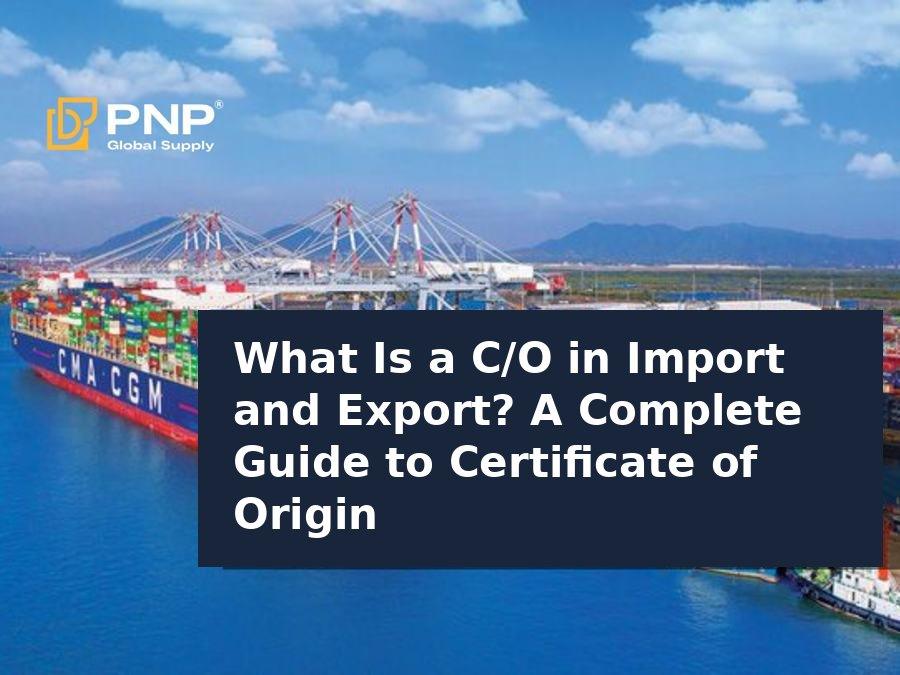
What is a C/O in import and export? This is a common question among businesses involved in international trade. A C/O (Certificate of Origin) is a document certifying the origin of goods and plays an important role in obtaining preferential tariff treatment, completing export customs procedures, and complying with import and export tax regulations. This article provides a comprehensive overview of the concept, role, types of C/O, and application procedures under current regulations.
1. What Is a C/O in Import and Export and What Is Its Legal Basis?
1.1. What Is a C/O (Certificate of Origin) and What Role Does It Play?
A C/O (Certificate of Origin) is a document certifying the country or territory of origin of goods. It is used to prove product origin, obtain preferential tariff treatment under FTAs, and facilitate customs clearance.
1.2. Legal Basis for C/O in Vietnam
The issuance and use of C/O certificates are governed by regulations issued by the Ministry of Industry and Trade, rules of origin, and free trade agreements to which Vietnam is a member. Businesses must comply with these regulations to qualify for preferential treatment and avoid risks during customs clearance.
2. What Types of Certificates of Origin Are Available?
2.1. Preferential C/O

- Applies to goods that meet the rules of origin under applicable FTAs.
- Helps businesses obtain preferential, reduced, or exempt import tariff rates when eligible.
- Enhances competitiveness in international markets.
- Common forms include Form D, E, AK, VK, CPTPP, EUR.1, and RCEP.
2.2. Non-Preferential C/O
- Certifies the origin of goods but does not provide preferential tariff treatment.
- Used when customs authorities or business partners require proof of origin.
- Supports trade management and compliance with import requirements.
- A common form is Form B.
2.3. Common C/O Forms in Vietnam
- Form D: ASEAN.
- Form E: ASEAN – China.
- Form AK: ASEAN – Korea.
- Form VK: Vietnam – Korea.
- CPTPP Form: CPTPP member countries.
- EUR.1: EVFTA.
- RCEP Form: RCEP member countries.
- Form B: Non-preferential C/O.
3. Requirements, Documents, and Procedures for Applying for a C/O in Vietnam
3.1. Requirements for Obtaining a C/O
- The goods must satisfy the applicable rules of origin.
- The business must have documents proving the origin of the goods.
- All documents and supporting information must be consistent.
- The business must meet legal requirements and use the correct C/O form.
3.2. Required Documents and C/O-Issuing Authorities
- The application generally includes an application form, Commercial Invoice, Packing List, customs declaration, Bill of Lading, and other relevant documents.
- Certain products may require additional material declarations or production process documentation.
- C/O certificates are issued by the Ministry of Industry and Trade, VCCI, and authorized issuing organizations.
3.3. Procedures for Applying for a C/O
- Step 1: Prepare the required documents and check all information for accuracy and consistency.
- Step 2: Submit the application through the electronic system or directly, as applicable.
- Step 3: The C/O issuing authority reviews and assesses the application dossier.
- Step 4: If all requirements are satisfied, the C/O is issued. If not, the business must provide additional or revised documents.
- Step 5: Receive the C/O and use it as part of export documentation, customs procedures, and preferential tariff application if eligible.
4. Important Notes When Using a C/O
4.1. Validity Period of a C/O
- The validity period depends on the applicable trade agreement and the regulations of the importing country.
- Businesses should submit the C/O within the required timeframe and carefully check all information before customs clearance.
4.2. Common Errors When Applying for and Using a C/O
- Incorrect business information.
- Incorrect HS Code or origin criterion.
- Missing or inconsistent supporting documents.
- Using the wrong C/O form or submitting the C/O after the required deadline.
4.3. Difference Between C/O and C/Q
- C/O: Certificate of Origin.
- C/Q: Certificate of Quality.
- Each certificate serves a different purpose and is used according to the requirements of the destination market or business partner.
5. How Can Vietnam Logistics Services Support C/O Applications?
5.1. Consulting on Rules of Origin
- Determine the applicable origin criteria.
- Select the correct C/O form.
- Check whether the goods meet the requirements for C/O issuance.
5.2. Supporting Document Preparation and C/O Application
- Check the validity and completeness of the application dossier.
- Prepare the required documents.
- Support or represent businesses in carrying out C/O application procedures.
5.3. Supporting Export Customs Procedures
- Prepare and submit customs declarations.
- Cross-check C/O information against customs documentation.
- Minimize errors and customs clearance risks.
5.4. Consulting on Import and Export Tax Regulations
- Advise on FTA tariff preferences.
- Guide businesses on the correct application of tax policies.
- Optimize import and export costs.
In practice, many businesses face difficulties when determining rules of origin, preparing documents, or completing customs procedures. With experience in Vietnam logistics services, PNP Global Supply supports businesses with rules-of-origin consulting, C/O application services, export customs procedures, and preferential tariff guidance, helping businesses save time, reduce risks, and optimize import and export costs.
6. Conclusion
Understanding what a C/O is in import and export is an important step for businesses to comply with rules of origin, prepare complete documentation, and select the appropriate type of C/O for each market. Using a C/O correctly not only helps businesses obtain preferential tariff treatment and facilitate customs clearance but also contributes to improving efficiency and competitiveness in international trade.
Contact Us
Facebook: PNP Logistics
Phone: 039 880 2946
Email: info@pnpglobalsupply.com